


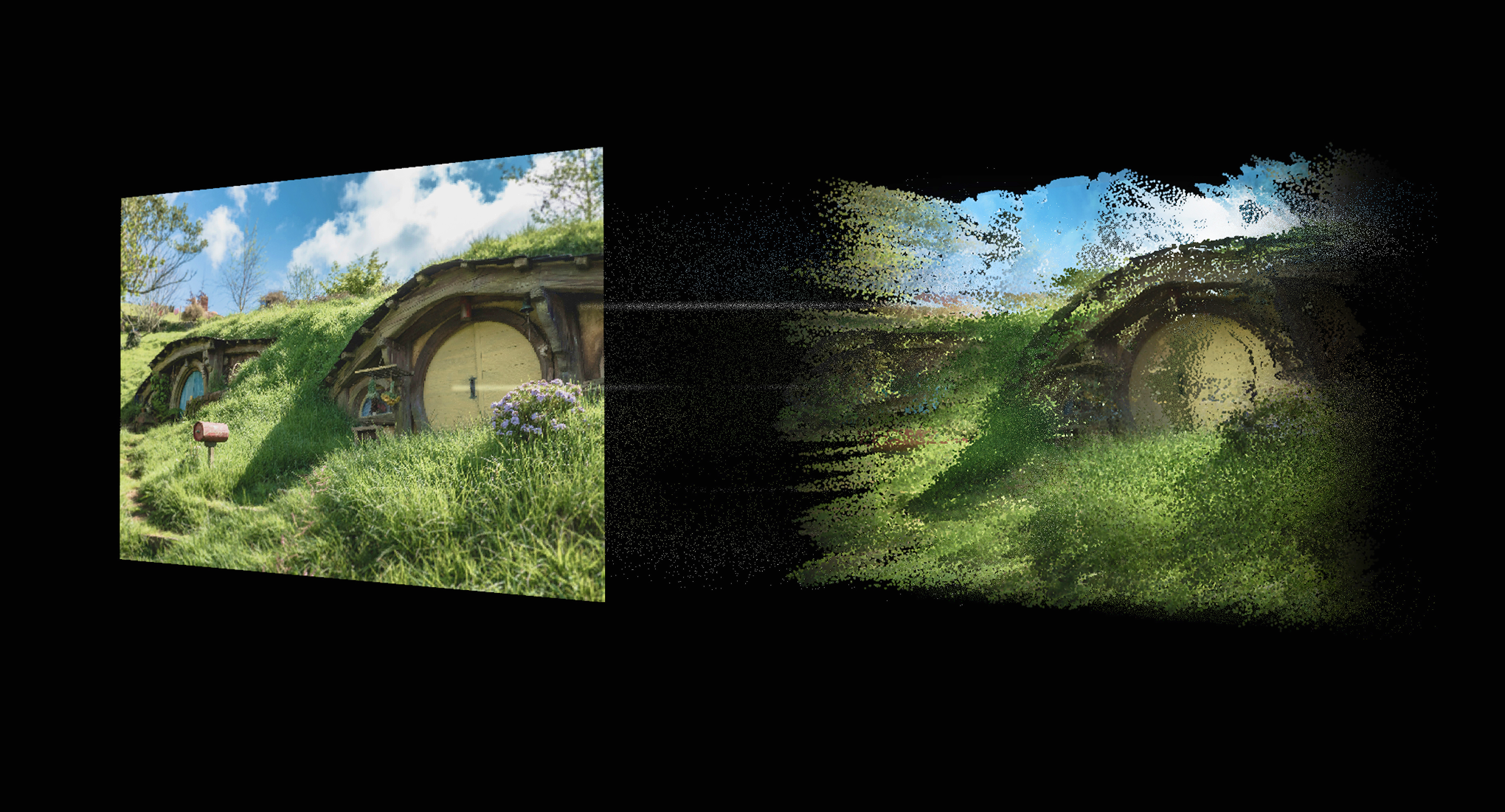
When every 2D video can gain depth without causing eye strain, you're not just watching content—you're stepping into it.
The promise of instantly converting any 2D movie, show, or game into immersive 3D is captivating. It's a feature now touted by several AR brands. Yet, for many users, the reality has been disappointing: flat-looking scenes with unconvincing depth, jarring visual errors, and, most critically, eye strain and dizziness that make the experience unsustainable.
This widespread issue isn't a matter of intent but of technological foundation. Most solutions rely on limited computer vision algorithms or smaller AI models that make basic depth guesses. They see an object and push it back a bit, but they fail to truly understand the complex layers and spatial relationships of a scene. The result is a poor approximation that confuses your brain's visual processing, leading to discomfort.
INAIR approached this challenge differently. We asked: what would it take to not just simulate depth, but to intelligently reconstruct it with the accuracy and coherence the human visual system expects? The answer lies in a more powerful architectural choice: a Vision Transformer (ViT) model.
01 The Architectural Divide: Small Models vs. Large Foundation Models
To understand why INAIR's 3D feels different, it's essential to understand the underlying technology.
Conventional Approaches (Xreal, Viture Neckband): These typically employ smaller, specialized models or traditional computer vision algorithms. They are efficient but limited in "scene understanding." They might identify a person and separate them from the background, but struggle with complex scenery, transparency, reflections, or detailed object interactions. This partial understanding creates inconsistent depth maps—objects might have depth, but the space between them feels wrong. This discrepancy is a primary cause of visual discomfort and the "cardboard cutout" effect.
INAIR's Approach (Vision Transformer Model): Instead of a small, task-specific model, INAIR's AI 3D Rendering Engine is built upon a large-scale Vision Transformer (ViT) architecture. Inspired by the transformers that revolutionized language AI, ViT models are "foundation models" trained on vast and diverse datasets of images and scenes.
This training allows them to develop a profound, contextual understanding of visual elements. The model doesn't just see "a car in front of a building"; it understands the car's contours, the building's facade, the windows, the street between them, and the spatial plausibility of how these elements coexist in three dimensions. It infers depth based on a holistic comprehension of the entire scene.
02 From Inference to Experience: Why This Distinction Matters for You
This technical divergence translates directly to what you see and feel.
-
In terms of depth accuracy, conventional solutions often produce effects that appear flat or merely layered in a simple manner, struggling to render subtle gradients. In contrast, INAIR's ViT-based engine constructs nuanced, naturally continuous depth, delivering convincing smooth transitions from the foreground to the background.
-
When handling complex objects, small models are prone to misjudging overlapping or intricately structured elements. INAIR's engine, however, intelligently processes occlusions, transparent materials like glass and water, and accurately restores intricate details.
-
Regarding overall scene coherence, traditional methods may apply inconsistent depth across different areas of the frame, leading to a disjointed feel. INAIR's engine is dedicated to generating a unified, physically plausible, and stable 3D space, ensuring the sense of immersion is consistent throughout.
-
This directly impacts wearing comfort. Traditional techniques carry a higher risk of causing eye fatigue and dizziness due to visual discord. INAIR's solution, aimed at visual harmony, significantly reduces cognitive load on the brain, thereby enhancing comfort for extended viewing sessions.
-
Finally, in content adaptability, traditional solutions might perform acceptably on simple scenes but often fail with complex, dynamic video. INAIR's engine delivers robust and stable 3D conversion performance across a vast spectrum of content, from animation to live-action footage.
In practice, this means watching a nature documentary where the rainforest canopy has layers upon layers of life, or an action scene where debris flies towards you with believable trajectory—all without the headache.
03 The INAIR AI 3D Rendering Engine: A System, Not Just a Feature
The ViT model is the core of a dedicated rendering pipeline within the INAIR Pod. This system-on-a-chip is designed to run this complex AI inference in real-time, alongside the spatial OS, ensuring there is no perceptible lag between the source video and your immersive 3D experience.
It is this combination of advanced AI architecture and purpose-built hardware that enables "Spatial Cinema" – our term for the comfortable, deep, and captivating 3D that transforms your existing content library into a new experience.
04 The Result: A New Category of Spatial Entertainment
The outcome is more than a checkbox feature. It’s the foundation for a new type of media consumption:
-
Your Library, Reborn: Every show in your Netflix queue, every YouTube travel vlog, becomes a fresh experience.
-
Comfort for Long Sessions: Technology should enhance enjoyment, not hinder it. Our focus on visual coherence makes extended viewing sessions not just possible, but pleasurable.
-
The True Potential of AR: This demonstrates how sophisticated AI can unlock the core promise of augmented and spatial computing: to seamlessly blend digital enhancement with human perception in a natural, comfortable way.
The race to convert 2D to 3D is not about who does it first, but who does it right. By grounding our technology in a powerful Vision Transformer model, INAIR has moved beyond visual tricks to achieve intelligent scene reconstruction. This commitment to foundational AI research is what separates a fleeting gimmick from a lasting, comfortable, and truly transformative spatial experience.
The future of immersive media isn't just about adding a third dimension—it's about adding intelligent depth.
Q&A: Demystifying INAIR's AI-Powered 3D
Q1: Why do some other 2D-to-3D features cause eye strain or dizziness, but INAIR's doesn't?
A: The discomfort often stems from incoherent depth maps. Conventional methods using smaller algorithms can misjudge spatial relationships, creating conflicting visual cues—like a person appearing at one depth while the ground they stand on appears at another. This "visual discord" forces your brain to work harder to make sense of the scene, leading to fatigue and dizziness. INAIR's Vision Transformer (ViT) model is trained for holistic scene understanding. It reconstructs depth by comprehending how all elements in a frame relate to each other in 3D space, resulting in a unified, plausible scene that aligns with your brain's natural visual processing, thereby enhancing comfort.
Q2: What exactly is a Vision Transformer (ViT) model, and why is it better for this task?
A: A Vision Transformer is a type of large-scale, foundational AI architecture. Unlike task-specific small models that make localized guesses, a ViT is trained on massive, diverse image datasets. This allows it to develop a contextual understanding of a scene. It doesn't just detect objects; it understands their form, textures, occlusions, and how light interacts with them. For 2D-to-3D conversion, this means it can infer highly accurate and nuanced depth by analyzing the entire global context of a video frame, leading to superior results in complex scenarios with transparency, reflections, or intricate details.
Q3: Does this advanced AI processing require special hardware or cause lag?
A: The INAIR AI 3D Rendering Engine, with the ViT model at its core, is integrated into a dedicated processing pipeline within the INAIR Pod. This system-on-a-chip is specifically designed to run this complex inference in real-time. It works in tandem with the spatial operating system to ensure there is no perceptible lag between the source video and the immersive 3D output you experience. The hardware is built for this purpose.
Q4: Is the "Spatial Cinema" experience only good for certain types of videos?
A: A key advantage of the ViT-based foundation model is its robust adaptability. While simpler algorithms might only work well on straightforward, high-contrast scenes, INAIR's engine delivers stable and convincing 3D across a vast spectrum of content. This includes everything from fast-paced action movies and nature documentaries with complex layers to animated films and standard TV shows. The technology is designed to intelligently handle diverse visual styles.
Q5: How does this foundational AI research benefit the user beyond just 3D conversion?
A: Investing in a powerful, general-purpose foundation model like ViT creates a robust platform for future intelligent features. The deep scene understanding it provides is the cornerstone for "Spatial Cinema" today, but it also paves the way for more advanced AR interactions and spatial computing applications down the line. It reflects a commitment to building a comfortable and coherent spatial experience, not just implementing isolated visual effects.
Share:
Unlock More Screens: INAIR Pod Now Brings Its Spatial Magic to Popular Third-Party AR Glasses
Why INAIR is the AR That Grows With You: The Wireless Update That Proves It